HiltonHeadRealtySales.com's Blog

Aug. 18, 2015

Get Ready for College

rental advantages.png

One of the important things as a parent is to plan for their children’s education. Let’s look at two different approaches: a savings account or investing in rental real estate.

Assuming your child is five years old and you start putting $250 a month in a savings account earning 2%, in 13 years you’d have $44,497.41 to pay for their college. Anticipating that isn’t going to be enough, you’d have to save $500 a month to end up with $88,995.

Another way would be to make a lump sum contribution of $20,000 today in a mutual fund earning 5% that would be worth $37,713 in 13 years. You’d have to make a $47,196 initial contribution to end up with the same $88,995.

View More
Aug. 15, 2015

Foreclosures Plunge and Overall Household Debt Remains Flat

Household debt balances were largely flat in the second quarter of this year, according to the Federal Reserve Bank of New York’s Household Debt and Credit Report. Total indebtedness increased just $2 billion from Q1 2015. Foreclosures hit their lowest point in the 16-year history of the New York Fed’s Consumer Credit Panel, a nationally representative sample drawn from anonymized Equifax credit data.

Auto loan originations reached a 10-year high in the second quarter, at $119 billion, supporting a $38 billion increase in the aggregate auto loan balance, which has now passed $1 trillion. The increase in auto loans also drove most of the $67 billion increase in non-housing debt balances. Credit card balances increased, by $19 billion, to $703 billion, while student loan balances remained flat. Mortgage balances and HELOC dropped by $55 billion and $11 billion, respectively.

There were $466 billion in new mortgage originations in the second quarter. Two new charts introduced in this quarter’s report show that just under half of the Q2 strength in originations were driven by borrowers with credit scores over 780. By contrast, only 8 percent ($38 billion) of all new mortgages were originated by borrowers with credit scores below 660.

View More
Aug. 11, 2015

Wait a Year...It Won't Matter?

There is a frequently quoted expression “more money has been lost from indecision than was ever lost from making a bad decision.” Regardless of the extent of its accuracy, most people can recall when procrastination has cost them money.

2015-16-250.jpg

There are markets so short of inventory that buyers have become frustrated after losing bids for several homes and have decided to wait until more homes come on the market. In the meantime, the shortage of homes is driving the prices up more by the month.

There are buyers who can’t find what they want for the price they want to pay and think that waiting will somehow change things. In some cases, what they want just keeps moving farther and farther away from them.

View More
Aug. 4, 2015

Who is Your Champion?

champion-200.jpg

The Super Bowl and World Series determine the football and baseball champions. Since there can only be one champion, the other team loses the competition. In feudal times, a knight might champion for the king or a patriotic, romantic or religious cause.

Fierce competition can occur when buying or selling a home because each party wants to get the “best deal” possible. When the buyer and seller are not equally matched, and they rarely are, it is important to have a champion on your side to fight for your cause.

View More
July 28, 2015

It's Hard to Imagine

With mortgage rates below 5% since 2009, you’d think any homeowner who should refinance would have already. However, it is estimated, there are approximately 6.5 million borrowers who would benefit with significant monthly savings by refinancing. iStock_000064771413_300.jpg

Rodney Anderson of Supreme Lending, on his weekly radio program, described a recent pipeline meeting where they reviewed every pending mortgage application his company was processing. They had seven refinancing applicants whose current mortgage was over 9% and twelve with a rate between 7% and 9%.

“Some 550,000 American homeowners with a mortgage could save $500 or more each month by refinancing at today’s rates. Over three million could save at least $200 per month.” said Ben Graboske, CTO with Black Knight Financial Services.

View More
July 19, 2015

Bidding Wars Still Dominate Low-Inventory Markets

While the pace of home-buying activities picks up around the nation, certain areas are seeing more excitement than others.

As is usually the case during economic recoveries, no two cities recover in exactly the same way. Some have a glut of inventory that will take many years to turn over, and other markets such as New York City, Denver and San Francisco have barely any inventory left at all, and each new listing seems to spark a vicious bidding war that drives the price far beyond a property’s appraised value.

Seattle falls in the latter category.

“In Seattle right now, it’s usually more than two buyers,” says Sam DeBord, managing broker of a Seattle real estate firm. “We hear about a 20-plus offer bidding war weekly. In most cases, it’s closer to five offers.”

DeBord, who is also the state director of Seattle King County REALTORS®, says that institutional investors often bid the most aggressively and get the higher-priced deals; however, it’s the so-called “regular” buyer—the one who will actually move into and live in the property for at least a few years—who comprises each side of a typical Seattle bidding war.

View More
July 19, 2015

May Home Prices Up 1.2 Percent

In a sign that the U.S. housing market is on track for a strong spring/summer buying season, home prices continue to show solid gains in May, according to the latest FNC Residential Price Index™ (RPI). Prices across the country climbed 1.2 percent following an upwardly-revised April, which saw the largest March-to-April seasonal gain since 2005.

With homes selling at rapid pace, supply in many local markets remains relatively challenged amid rising sales. "While the participation of first-time home buyers has reportedly reached record highs, rising demand from potential trade-up buyers has also contributed importantly to the price growth in many markets,” says Bob Dorsey, FNC's chief data and analytics officer. "Trade-up buyers continue to capture moderate to modest gains on their investment; in May 2015, realized home price appreciation, measured at an annualized rate, averages 2.6 percent across the country."

Foreclosure sales have dropped to their lowest levels since October 2007. In May 2015, completed final sales of foreclosed and REO properties comprised about 10.3 percent of total existing home sales, a decline of nearly two percentage points from April's 12.2 percent.
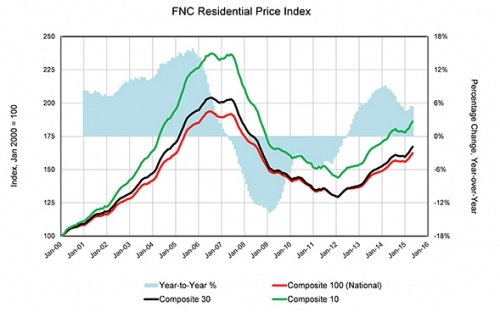
Average time-on-market drops rapidly, down to 85 days in June, compared to 96 days in May. Meanwhile, sellers are taking smaller cuts off their asking price, averaging 3.1 percent in May, compared to April's 3.6 percent. Preliminary June estimates show a continued drop in the asking price discount nationwide, with buyers in the San Francisco market bidding up prices to pay an average of 4.8 percent above the listing price.

View More
July 16, 2015

Home Warranties Offer Great Benefits to Real Estate Agents, Sellers and Buyers

If there was a magic formula for selling real estate quickly and easily, you can bet every real estate agent would be signing up. Real estate sales affect agents, buyers and sellers one way or another. Although homes need to be in good condition and offer what buyers are currently seeking, ultimately the real estate agent drives the sales. To stay on top of their game and work a little magic, smart agents have learned that a home warranty, also called a home protection plan, can work miracles for increasing sales and quick turnarounds. Learn how agents, sellers and buyers benefit from home warranties and all come out winners.

Home Warranties

Home warranty programs are available for purchase by consumers who want protection for home appliances and major home systems in the event they fail or break down. If any of the items under warranty in the program should fail, the consumer simply contacts the home warranty company and they see to it that the item is inspected, repaired or replaced by a qualified contractor.

Agents Start the Process

Once a real estate agent learns about the advantages of home warranty programs, work takes on new meaning and they see the possibilities for success. Skeptical buyers are no longer afraid to consider older homes when sellers pay for a home warranty. After an agent explains that the warranty covers appliances and major heating, electrical and cooling systems, clients become eager to see a home that was once not considered. The agent just got a shot at another sale!

View More
July 7, 2015

Just In: Additional Steps to Spur Affordable Housing

The Federal Housing Administration (FHA) recently published a notice providing guidance on the new Small Buildings Risk Sharing (SBRS) Initiative. SBRS invites new private sector high-capacity lenders to partner with FHA to provide long-term fixed-rate lending products to multifamily property owners with mortgages of $3 million and up to $5 million in high-cost areas. SBRS builds on the successful record of affordable housing lending under HUD’s existing Risk Sharing programs with state and local housing finance agencies as well as Fannie Mae and Freddie Mac.

“Communities across the nation are seeking ways to support affordable housing production and preservation,” says Ed Golding, principal deputy assistant secretary for HUD’s Office of Housing. “The risk share initiative allows us to target our products to an important and underserved part of the rental market by partnering with CDFIs and other lenders who have on the ground relationships with small building owners in their communities. By offering FHA mortgage insurance and facilitating access to long-term fixed rate capital, we can help preserve affordable housing for property owners and tenants.”

Small buildings comprise 34 percent of the total 17.5 million multifamily rental units in the U.S., housing nearly 6 million households and, on average, offer lower rents than larger properties. Nearly 60 percent of small rental property owners are individuals, households and estates who face significant constraints accessing financing due to more stringent credit standards than larger property owners and the loss of many local banks after the 2008 recession. SBRS is designed to encourage lenders to enter this market and provide long-term, fixed rate capital to small building owners.

View More
May 27, 2015

March Home Prices Continue to Rise

According to FNC’s Residential Price Index™ (RPI), U.S. home prices continued to rise at a brisk pace in March and up 0.9 percent nationwide.

March’s increase follows a strong momentum in February that recorded some of the largest unseasonable gains in many of the nation’s key housing markets. With continued low interest rates and easing credits, particularly recently launched low-down-payment conventional loans by Fannie Mae and Freddie, home prices are positioned for strong gains. This spring/summer home buying season already appears well under way across the West, South, and Midwest regions.

The latest development in the for-sale market shows the pace of home sales has picked up rapidly since March. The median time-on-market is down from 128 days in March to 106 days in April, the fastest seasonal pace for the month of April since the housing market began to recover in early 2012. The average asking-price discount is 3.3 percent, down from 4.2 percent in March.

View More
Posted in Market Trends