HiltonHeadRealtySales.com's Blog

May 26, 2015

Who would want to be without one?

When the 75 year old man who had been widowed four times was asked why he was getting married again, he said “for the little bit that they eat, I wouldn’t want to be without one.”

In a torrential rainfall, you wouldn’t want to be without an umbrella. It is also understandable that when purchasing or selling a home, more and more people want an agent involved.

NAR’s Homebuyers and Sellers Profile states the trend in owners trying to sell their home themselves has declined over the past ten years from 14% in 2003 to only 9% in 2014. Similarly, the number of buyers purchasing directly through an owner has decreased from 2001 to 2014 from 15% to 5%.

View More
May 19, 2015

Brokers Welcome Greater Data Control as NAR Approves Funding for Upstream

This past Saturday during the 2015 REALTORS® Legislative Meetings & Trade Expo in Washington, D.C., the NAR Board of Directors approved a partnership between the National Association of REALTORS® (NAR) and its wholly owned subsidiary Realtors Property Resource® (RPR) and UpstreamRE, LLC, to create a nationwide broker data-entry and collection system using the RPR advanced Multi-list platform (AMP™). The initiative, designed to provide efficiency by giving brokerages a single place to input listing data on multiple platforms online—including Realtor.com®, local MLSs, and broker websites—will be funded using NAR operating reserves over 36 months, at a net amount not to exceed $12 million.

According to NAR, industry leaders have been working together to address data problems for years, and created the concept called “Upstream” approximately two years ago; the WAV Group was enlisted to consult on the technical side of the development of the project and released full details on the project last week.

View More
Posted in Realtors
May 19, 2015

You've Got Money!

Imagine that after checking www.SSA.gov to see what you can expect when you retire and estimated what your minimum required distributions from your retirement accounts will be, you’ve discovered that you’re not going to have enough retirement income to cover your living expenses.

Youve got money.jpg

Ideally, it would be perfect if the extra money you need would just come to your mailbox each month with the same certainty as your social security or retirement income.

Rental homes are a popular choice for passive income because they are an investment that most people understand based on their experience owning a home. They’re easy to manage and the rents should keep pace with inflation.

View More
May 19, 2015

How Much Would Your Favorite TV Homes Cost in Real Life?

From Roseanne Conner's home in the fictional Lanford, Ill. to the Dunphy's gorgeous space in West Los Angeles, Calif., it's fun to imagine what the real-life homes of our favorite families from television history would've cost. (There's no question Phil Dunphy found himself a great deal—he is a REALTOR® after all!)

To estimate the cost of these screen-famous homes, Trulia examined the median value of similarly-sized homes in each TV family's neighborhood, city or ZIP code, and shared their findings and fun facts in this handy infographic. (Aside: Where a show is set isn't always the filming location...but just go with it!)

Whether these homes actually exist or just survive in the land of TV nostalgia, let's pretend that our favorite characters are somehow real and living in a parallel universe as we compare the costs of housing in their various markets.


May 19, 2015

How to Squeeze More Home Improvements into a Tight Budget

With all the attention we tend to want to lavish around the outside of our homes, it's hard to withhold any funds to freshen up the inside this spring. But Doug Chapman at homedaddys.com recently posted a handy punch list of decorating ideas you can accomplish while keeping within a tight budget:

Chapman says one of the simplest ways to add flavor to your new home while being on a budget is to look at the flooring. You don’t have automatically put new flooring in – whether it is carpet or hardwood floors – you could also add a special little touch with an area rug.

Another thing, Chapman says—don’t use all of your financial resources in just one room. Since the kitchen and living room are most popular for gathering—make sure to spread finances out and focus more on those spaces.

At the same time, Chapman says not put all your marbles in those two baskets—save money for the bathrooms, master bedroom and also the common foyer area. You want to make sure to add a little personal touch in each area.

View More
May 16, 2015

Amortization

The word describes the process of accounting that will repay a loan over time. Residential buyers will most commonly be required to have an amortized mortgage.

When amortizing a fixed rate mortgage, the payment remains constant for the entire term but the allocation of what goes to principal and interest changes with each payment that is made. Since an amount of each payment retires the principal, the interest due on the next payment is calculated on the unpaid balance after the previous payment was made. amortization schedule.png

This means that an increasing amount is applied to principal on each payment while the amount owed in interest decreases. If normal payments are made each time, on time, the loan will be completed paid off at the end of the term.

View More
May 12, 2015

Live the Dream

Consumers are more easily living the American Dream of owning a home because of the incredibly low mortgage rates. Today, most buyers can get a much lower rate than their parents or grandparents got on their first home.

American dream2.png

In a recent housing survey, FNMA released information about consumers' thoughts on the current market. Almost two-thirds would rather buy than rent and believe that now is a good time to buy. Half of the respondents expect rent and home prices will go up.

Top Ten reasons to move the dream to reality:

  1. It’s cheaper than renting in most cases
  2. Avoid rental increases in the future
  3. Equity build-up with amortization of each payment going to principal
  4. A home is a forced savings account
  5. Appreciation increases your equity and your overall investment
  6. Mortgage interest and property tax deductions
  7. Home equity interest deduction
  8. A place you can call your own
  9. A place to share with friends and family
  10. Capital gains exclusion on profit
View More
April 23, 2015

Looking to Lower Your Mortgage? Keep These Simple Tips in Mind

With interest rates at historic lows over the past few years, homeowners across the board jumped on the refinancing bandwagon in order to get better rates and lower payments. But refinancing isn’t the only way to lower your mortgage. And if you’re a new buyer just looking into obtaining a mortgage, there are ways to get a lower mortgage rate from the start.

Here are a few tips to keep in mind if you’re looking to decrease your mortgage—or for anyone who’s knee-deep in the process of searching for the best mortgage to fit their needs.

Switch Commitment. You may have thought a 15-year mortgage was the best option when you first bought your home, but perhaps circumstances have changed and it no longer makes sense. In that case, transfer your mortgage to a 30-year mortgage and you will be greatly decreasing the amount of your mortgage payment each month. While you may be paying more in the long run, odds are you’ll be selling your home before the 30-year period is up anyway, so it makes sense if you need the money now.

Lower Your PMI. Earlier this year, the Federal Housing Administration announced that all FHA loans would have lower rates, resulting in more than two million FHA homeowners saving roughly $900 a year by refinancing. In addition, the U.S. Department of Housing and Urban Development released a report that showed that the lower PMI will result in 250,000 home purchases for first-time homebuyers.

View More

April 22, 2015

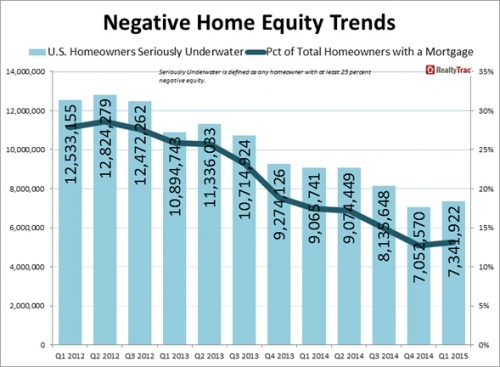
Share of Seriously Underwater Homes Increases in First Quarter for First Time Since 2012

RealtyTrac® recently released its U.S. Home Equity & Underwater Report for the first quarter of 2015, which shows that at the end of the first quarter of 2015 there were 7,341,922 U.S. residential properties seriously underwater — where the combined loan amount secured by the property is at least 25 percent higher than the property’s estimated market value — representing 13.2 percent of all properties with a mortgage.
 
The share of seriously underwater homeowners increased 0.4 percentage points from Q4 2014 — the first quarterly increase since the second quarter of 20120 — but still down more than 4 percentage points from a year ago.
 

“At the end of 2014 we saw the lowest share of seriously underwater properties since we began tracking such data, but in the first quarter that share bumped up slightly as home price appreciation continued to slow down in many markets,” says Daren Blomquist, vice president at RealtyTrac. “In addition, the data indicates more owners who have regained equity listed and sold their homes in the first quarter, cashing out on some of the home equity on the table in the U.S. housing market. The biggest change in the equity landscape nationwide was in the category of homeowners with between 20 and 50 percent equity, which saw a net decrease of nearly half a million between the end of the fourth quarter and the end of the first quarter.

View More
April 21, 2015

Are You Ready for 'Owning a Home'?

I am always thrilled to hear when folks make the jump to home ownership. And it's important for prospective homeowners to know about all the resources available to them to help the experience go as smoothly as possible, especially when it comes to financing.

Earlier this year, the U.S. Consumer Finance Protection Bureau (consumerfinance.gov) released a report with some revealing data - particularly that almost half of consumers do not shop around for a mortgage when purchasing a home.

The report highlights the fact that informed consumers are more likely to shop, especially if they are familiar with available mortgage rates. As part of its "Know Before You Owe" mortgage initiative, the CFPB also announced it was releasing “Owning a Home,” an interactive, online toolkit designed to help consumers as they shop for a mortgage.

Upon reviewing the findings, CFPB Director Richard Cordray noted that consumers put great thought into the choice of a home, but the mortgage process continues to be intimidating. So our two-part report will detail some of the key data coming out of this study, and how to apply the information to your own home buying experience.

View More