HiltonHeadRealtySales.com's Blog

Oct. 10, 2014

U.S. Foreclosure Activity Edges Up with First Increase in Three Years

According to RealtyTrac®'s recently released U.S. Foreclosure Market Report™ for September and the third quarter of 2014, foreclosure filings — default notices, scheduled auctions and bank repossessions — were reported on 317,171 U.S. properties in the third quarter, down 16 percent from a year ago but up 0.42 percent from the previous quarter — marking the first quarterly increase since the third quarter of 2011.

The quarterly increase in overall foreclosure activity was driven by a 2 percent increase in default notices (LIS, NOD) and a 7 percent quarterly increase in scheduled foreclosure auctions (NFS, NTS). Meanwhile bank repossessions (REOs) decreased 12 percent from the previous quarter.

A total of 106,866 U.S. properties had foreclosure filings in September, down 9 percent from the previous month and down 19 percent from a year ago to the lowest level since July 2006 — a 98-month low. September marked the 48th consecutive month where U.S. foreclosure activity decreased on a year-over-year basis.
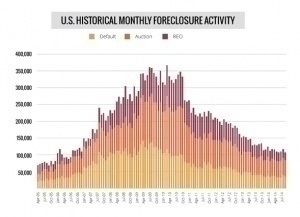
“September foreclosure activity was back to pre-housing bubble levels nationwide, in large part thanks to a continued slide in bank repossessions,” said Daren Blomquist, vice president at RealtyTrac. “However, a recent rise in scheduled foreclosure auctions in many markets across the country shows lenders are continuing to clean house of lingering delinquent loans. This rise in scheduled auctions foreshadows a corresponding rise in bank repossessions and auction sales to third party buyers in the coming months.”

View More
Oct. 7, 2014

Opportunity Costs

iStock_000003622913X200x200.jpg

Sometimes, there are costs associated with not taking a particular action. If a person left their money in a certificate of deposit earning 2% when they could have made an investment that earned 8%, the difference is the opportunity costs associated to not taking action.

If a couple has a down payment and good credit, locking in a low interest rate mortgage for 30 years could easily provide their lowest cost of housing. If that couple waits three years to purchase a home, the price would probably be higher as would the mortgage rate.

However, assuming the price and interest rate remained constant, look at what the opportunity costs might be compared to doing nothing.

If their money was invested in a certificate of deposit at 2.00%, in two years their $8,750 would have grown to $9,104. They would have earned $354 and had to pay ordinary income tax on the interest.

If their money was invested in the stock market that had increased 7%, in two years they would have a profit of $1,268 which would be subject to long-term capital gains tax.

View More
Sept. 25, 2014

REALTORS Say UAVs Could be Game Changer for Industry, Want FAA Approval

REALTORS® are showing tremendous interest and enthusiasm for new drone (Unmanned Aerial Vehicle) technologies that could help them market listings in an efficient and environmentally sensible manner. But for now, the Federal Aviation Administration does not permit the use of UAVs for commercial purposes such as the marketing of real estate.

Recently, the National Association of REALTORS® responded to the FAA’s prohibition on the use of UAVs by calling on the agency to quickly come up with a framework for commercial use of UAV technology that addresses safety and privacy concerns, but permits a commercial UAV industry to flourish.

The letter outlines the following points:

- The potential of using UAV technology to collect images is also a game-changer for the real estate industry.

- UAV-obtained images are a cost-effective way to get more information to the consumer. The cost is very small compared to existing methods, such as driving around a property or using a private helicopter or airplane.

View More
Sept. 24, 2014

Buying a Home from a Foreign Seller? Don't Forget FIRPTA!

Recently, I talked about the growing number of multicultural home buyers entering the American Real Estate market. But there is also some very important information American buyers need to heed if they are buying a home from a foreign owner.

Thomas L. Smitha, JD CPA is Associate Director of Tax Services at Berkowitz Pollack Brant Advisors and Accountants in Florida (bpbcpa.com). He recently warned about certain tax compliance hazards unwary buyers of homes and other types of foreign-owned real property could face.

Smitha warns that American buyers who fails to withhold 10 percent from the purchase price of foreign-owned properties to remit to the Internal Revenue Service may be held liable for a U.S. tax that foreign sellers are supposed to pay.

According to Smitha, a federal law known as FIRPTA (Foreign Investment in Real Property Tax Act of 1980), obligates buyers of land, homes, stock in real estate companies and other types of real property interests to determine, for tax withholding purposes, whether the seller is a tax resident of the United States or a foreign country.

View More
Sept. 22, 2014

Thinking Big, Living Small: Exploring the Micro Home Movement

With the market rebounding, many new buyers are entering the fold. For some, the appeal of a massive home with all of the latest bells and whistles has lost its luster, and they are looking for something smaller. They are going micro.

In the 2011 comedy “Wanderlust,” a New York City couple played by Paul Rudd and Jennifer Aniston purchase a pint-sized studio apartment (Murphy bed included) that their agent pitches to them as a “micro loft.” While this scenario pokes fun at the trend, it is a housing sector that, while still a niche, is gaining popularity.

In July of 2012, New York City Mayor Michael Bloomberg released plans for studio apartments that will be between 275 and 300 square feet—apartments so miniscule they are technically illegal, and require new zoning laws. Following suit, in September San Francisco builders started plans for even smaller micro-units—a precious 220 square feet per pad. Bloomberg believes the apartments are an answer to the demand for single person living—over 30 percent of New Yorkers live alone, and many more units are filled with couples with no children, who require less space.

But smaller homes don’t only provide habitats for the unattached; they create a smaller carbon footprint, force you to simplify your surroundings and require that you maintain an overall thriftier way of being. In an era where we think “face time” means video chat, where we spend more time Tweeting than talking and believe multitasking is a marketable skillset, then perhaps some are interested in simplifying their way of living by streamlining with a smaller space.

View More
Sept. 18, 2014

Be Wary of Fall Home Maintenance Scams

When autumn arrives, many homeowners prepare their homes for cooler weather by hiring specialists to clean and make repairs. Be mindful of cons during this time of year – scammers use this opportunity to swindle homeowners out of thousands of dollars for unnecessary work. Be wary of these four scams typically advertised during the fall season.

Chimney repairs – Scammers disguised as chimney sweeps will tell you your chimney needs to be inspected, and then use hard sales tactics to get you to make expensive, unfounded repairs. Don’t fall for it.

Gutter cleaning – Fraudulent gutter cleaners tend to prey on the elderly or those who cannot clean their gutters easily. They will assure you that they’ve worked in the neighborhood before, and quote you a very low estimate in return for shoddy, incomplete work.

View More
Sept. 13, 2014

Mortgage Applications Decrease in Latest September 2014 MBA Weekly Survey

Mortgage applications decreased 4.1 percent from one week earlier, according to data from the Mortgage Bankers Association’s (MBA) Weekly Mortgage Applications Survey for the week ending September 19, 2014.

The Market Composite Index, a measure of mortgage loan application volume, decreased 4.1 percent on a seasonally adjusted basis from one week earlier. On an unadjusted basis, the Index decreased 5 percent compared with the previous week. The Refinance Index decreased 7 percent from the previous week. The seasonally adjusted Purchase Index decreased 0.3 percent from one week earlier. The unadjusted Purchase Index decreased 2 percent compared with the previous week and was 16 percent lower than the same week one year ago.

The refinance share of mortgage activity decreased to 56 percent of total applications from 57 percent the previous week. The adjustable-rate mortgage (ARM) share of activity increased to 8.0 percent of total applications.

View More
Sept. 11, 2014

Q: What is a hybrid loan?

A: Also called a fixed-period ARM, these crossbreed loans combine features of fixed-rate and adjustable-rate mortgages.

They start out with a fixed interest rate for a number of years – usually 3, 5, 7 or 10 years – and then convert to an ARM.

Initially, the interest rate for the fixed period of the loan is much lower than the rate on a fixed-rate, 30-year mortgage by about 1.5 percentage points. As a result, the hybrid allows borrowers to buy a lot more home than they can afford – but at greater risk.

The terms and fees for these loans vary widely and when the fixed-rate period expires, homeowners could end up paying considerably more than the current rate of interest.

Before considering a hybrid, pay close attention to the terms, fees, and prepayment penalties.

Sept. 11, 2014

2015 Housing Forecast: Recovery Will Continue Gradually

Americans’ attitudes toward the housing market continued to soften in August and suggest that housing activity may resume its modest recovery in 2015 after some pullback this year, according to results from Fannie Mae’s August 2014 National Housing Survey. Despite ongoing improvements in the labor market this year, consumers’ view on their income trend during the past 12 months appears to be more bearish. In addition, the share of consumers who say now is a good time to buy a home dipped for the second consecutive month, falling six percentage points since June to 64 percent—tying the all-time survey low.

"The August National Housing Survey results lend support to our forecast that 2015 will likely not be a breakout year for housing," says Doug Duncan, senior vice president and chief economist at Fannie Mae. "The deterioration in consumer attitudes about the current home buying environment reflects a shift away from record home purchase affordability without enough momentum in consumer personal financial sentiment to compensate for it. To date, this year’s labor market strength has not translated into sufficient income gains to inspire confidence among consumers to purchase a home, even in the current favorable interest rate environment. Our third quarter Mortgage Lender Sentiment Survey results, to be released later this month, are expected to show whether mortgage demand from the lender perspective is in line with consumer housing sentiment."

Homeownership and Renting
•The average 12-month home price change expectation fell to 2.1 percent.

View More
Sept. 10, 2014

Commercial/Multifamily Delinquencies Continue Decline

Delinquency rates for commercial and multifamily mortgage loans continued to decline in the second quarter of 2014, according to the Mortgage Bankers Association’s (MBA) Commercial/Multifamily Delinquency Report.

During the second quarter of 2014, the 30+ day delinquency rate for loans held in commercial mortgage-backed securities (CMBS) decreased 0.45 percentage points to 5.71 percent. The 60+ day delinquency rate for multifamily loans held or insured by Fannie Mae was unchanged at 0.10 percent. The 60+ day delinquency rate for multifamily loans held or insured by Freddie Mac decreased 0.02 percentage points to 0.02 percent. The 60+ day delinquency rate for commercial and multifamily mortgages held in life company portfolios increased 0.03 percentage points to 0.08 percent. The 90+ day delinquency rate for loans held by FDIC-insured banks and thrifts decreased 0.17 percentage points to 1.40 percent.

“Commercial and multifamily mortgage performance continues to strengthen,” says Jamie Woodwell, MBA’s Vice President of Commercial Real Estate Research. “Delinquency rates for loans held by life companies, Fannie Mae and Freddie Mac all remain low, and delinquency rates for CMBS loans continue to decline. Among loans held on bank balance sheets, the 30-90 day delinquency rate is now the lowest in the series history, going back to 1993.”

View More