HiltonHeadRealtySales.com's Blog

Nov. 1, 2014

Relax...There's an Alternative

for rent-250.png

Is the stock market keeping you up at night? Are you consuming more antacids than ever before? Are the ups and downs causing more stress than you want or need? There is a simple alternative in rental real estate.

Single family homes for rental purposes offer an excellent rate of return in an investment that most people understand better than other investments. The concept is simple: stay with predominantly owner-occupied homes in a slightly below average price range. In most areas, tenants are easy to find and they’ll usually stay two to three years or more.

For the person who doesn’t want to be bothered with calls from tenants, professional management is available and commonly won’t dramatically affect the rate of return. Managers can achieve economies of scale that individuals can’t due to managing multiple properties and having good connections with the best workmen.

View More
Oct. 26, 2014

The International Homebuyer: Continued Interest in U.S.

Based on the National Association of REALTORS’® survey for the 12 months ending March 2014, the total volume of residential sales to international clients was estimated at approximately $92.2 billion, a 35 percent increase from the previous period’s level of $68.2 billion. The dollar level of international sales was roughly seven percent of the total U.S. Existing Homes Sales (EHS) market of $ 1.2 trillion for the same period. Compared to the previous year, sales to international buyers increased both in numbers of transactions and in average price.    


View More
Oct. 25, 2014

Where Are Homes Built on Private Wells and with Individual Septic Systems?

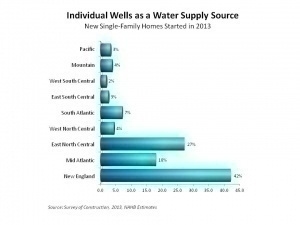
According to NAHB analysis of the Survey of Construction (SOC) data, only 8 percent of new single-family homes started in 2013 are served by individual wells and only 15 percent have private septic systems. These shares, however, vary widely across the nine Census divisions and reach 42 and 51 percent, respectively, in New England.

The SOC which is conducted by the US Census Bureau and partially funded by the Department of Housing and Urban Development (HUD) collects detailed information on physical and financial characteristics of newly-built single-family homes. The information comes from interviews of builders or owners of the selected new houses. About 1 in 50 new single-family homes are selected for interviews based on a sample of building permits and a canvassing of areas not requiring permits. This sample is large enough to provide estimates for nine Census divisions.

The SOC classifies sewage disposal systems as public sewers (including community or shared sewage/septic systems) and individual septic systems. Most of new single-family homes are serviced by public sewers. The incidence of individual septic systems among new single-family starts varies by region.

More than half of new single-family homes started in New England have private septic systems, while the national share is slightly above 15 percent. Individual septic systems are also more noticeable in the East South Central and East North Central division with the corresponding shares of 36 and 28 percent. The share of private septic systems is also above the national average in the Middle Atlantic division where it reaches 19 percent.

The common sources of water supply also differ noticeably by geographic location. Similarly to sewage/septic systems, the SOC classifies community or shared water supply/well as public and not individual wells. Nationally, only 8 percent of new single-family homes started in 2013 are served by individual wells, and the remaining vast majority of new homes are served by a public water system.

In New England, where new homes sit on nation’s largest lots and are more likely to be custom-built, 42 percent of new single-family homes are built on individual wells. The reliance on private wells is also relatively common in the East North Central and Middle Atlantic divisions where the corresponding shares are 27 and 18 percent.

In contrast, individual wells are almost non-existent in the West South Central and East South Central divisions where their shares are less than 2 and 3 percent, respectively.

View this original post on the NAHB blog, Eye on Housing.

Posted in Home Ownership
Oct. 25, 2014

Most Common Costly Mistakes Made by New Homeowners

You bought and own your own home. And something goes wrong. There’s a serious and expensive problem and you think it’s the builder’s fault or was caused by the remodeling contractor you hired. What are you going to do now?

Here are some of the most common costly mistakes made by new homeowners, brought to you by The Home Book – A Complete Guide to Homeowner and Homebuilder Responsibilities.

Storing Household Goods on Garage and Attic Trusses.
 Garage and attic trusses are designed to support the weight of the roof and ceiling and not the weight of anything else. Unfortunately, many homeowners view the space in the attic and above the garage ceiling as a great place for additional storage. Storing household goods in these areas can result in sagging and even a possible collapse of the roof structure. If a homeowner wishes to use this space for storage, a structural engineer should be consulted to determine if additional reinforcement is necessary.

View More
Oct. 24, 2014

Why Your Garage Door Color Matters

I have provided loads of information about your home's front door in our previous two reports, and today, we'll touch on one final and related subject - your garage doors. We recently became familiar with color designer, forecaster and renowned color consultant Kate Smith.

Smith's recent blog at sensationalcolor.com noted that the biggest mistake she sees homeowners making is using color to draw too much attention to their garage doors rather than downplaying them.

This is even more pronounced on a home with a protruding garage that already dominates the view of the home. The following points represent Smith's DO’s and DON’Ts for painting garage doors:

DO paint the garage doors in the same color as the house itself and not the trim color or white (unless white is your house color) if you want to keep them from standing out. Painting the garage doors the same colors as the body of the house may also make a home appear larger. 
DO paint the trim around the doors either to match the door or to match the trim on the rest of your home. Usually it looks best if it is the same as on the rest of your home but there are times when it may look better to not call attention to the trim with a contrasting color. 
DON’T paint the garage doors in the same accent color as the front door or shutters. This usually draws too much attention to the garage doors and chops up the facade of the home.

View More
Oct. 23, 2014

Mobile App Helps Agents Find What They Need Most

Before meeting with clients, you prepare. You find properties that meet their needs, set up alerts in your MLS to let them know when new properties come on the market, you’ve even sent them RPR reports that include photos, neighborhood information, basically everything your clients need to fall in love with a property without actually stepping foot inside. Now it’s time to show them the properties.

You have four stops prepared, and you’ve printed out materials for each home to remind them of the specifics of each house. Excited to show the properties to your clients, you head to the first property. The home shows well, and they like certain aspects of it, but it’s not “the one.” You travel on. Heading to home No. 2, your buyer points out the window at another home. Looks like it’s a FSBO; therefore, it isn’t on your list. But your clients seem really interested, so you pull over to the shoulder.

There are no flyers outside, nothing that gives any property information. And because it’s a For Sale by Owner, your options may seem limited. However, with RPR mobile™, you can not only access information on that property, you can instantly send that information to your buyers.

From the homepage of RPR mobile™, you search for properties around you and find the one you’re parked in front of. Looking at the property details, you see that house has 2 bedrooms, 1 1/2 bathrooms, 1,100 square feet and even has a pool in the backyard. But you know your client is searching for a four bedroom three bath. Because you had access to data on the home, you can quickly eliminate the home as an option, and continue to the next home. And just like that, you have satisfied your clients’ need for information, proving once again that REALTORS® are the local market experts.

Click here for more information on RPR mobile.

Posted in Realtors
Oct. 23, 2014

'Seriously' Underwater Properties at Lowest Level in Two Years

RealtyTrac®, a leading source for comprehensive housing data, today released its U.S. Home Equity & Underwater Report for the third quarter of 2014, which shows that 8.1 million U.S. residential properties were seriously underwater—where the combined loan amount secured by the property is at least 25 percent higher than the property’s estimated market value—representing 15 percent of all properties with a mortgage and an estimated $1.4 trillion in negative equity.

The third quarter negative equity numbers were down to the lowest level since RealtyTrac began reporting negative equity in the first quarter of 2012. In the previous quarter, 9.1 million residential properties representing 17 percent of all properties with a mortgage were seriously underwater, and in the third quarter of 2013 10.7 million residential properties representing 23 percent of all properties with a mortgage were seriously underwater. The recent peak in negative equity was in the second quarter of 2012, when 12.8 million U.S. residential properties representing 29 percent of all properties with a mortgage were seriously underwater.

The universe of equity-rich properties—those with at least 50 percent equity—grew to 10.8 million representing 20 percent of all properties with a mortgage in the third quarter, up from 9.9 million representing 19 percent of all properties with a mortgage in the second quarter of 2014. Collectively these equity rich homeowners have an estimated $2.9 trillion in positive equity.

View More
Oct. 23, 2014

How to Improve Your Company's Mood

Is your company in a bad mood? The signs aren’t always overt. People aren’t biting each other’s heads off or glaring sullenly across the conference table. (That’s home, not work!) Instead, it feels like everyone is just…coasting. Rather than digging for solutions, they make a cursory effort and then lay the problem at your feet. They’re not cage-rattlers and idea-sharers; they’re “yes men” and passive compliers. And if you could be the proverbial fly on the wall (instead of the boss in the hall), you suspect you’d hear far more complaining and blaming than the faked enthusiasm you usually hear.

That’s bad mood in workplace parlance. And author Michael Houlihan says your apathetic clock-punchers are the creations of a culture that’s set up to squelch their inner entrepreneur.

Jeff Hayzlett, who wrote the foreword of our new book, says bad mood comes from employees believing their best days are behind them, not ahead of them,” says Michael Houlihan, coauthor along with Bonnie Harvey of The Entrepreneurial Culture: 23 Ways to Engage and Empower Your People (Footnotes Press, 2014, ISBN: 978-0-9907937-0-0, $9.95, www.TheBarefootSpirit.com) and the New York Times bestseller The Barefoot Spirit: How Hardship, Hustle, and Heart Built America’s No. 1 Wine Brand. “I think that’s a brilliant way to put it. And of course, it’s culture that creates that belief—and it’s leaders who create the culture.”

Sometimes a culture’s mood sours over time, before you even know it’s happening. A stifling rule here, an ignored idea there, and before long you’ve zapped the entrepreneurial spirit that enabled your employees to create great things at your company in the first place. The only cure is to make your employees realize they really do have a stake in their future and the ability to make it a great one.

Of course, before you can shift a bad mood, you need to know you have one. Here are 11 red flags to look for:

Everyone plays the blame game. As soon as a ball is dropped, the finger-pointing and blame-dodging begins. “It was her responsibility, not mine!” “Don’t look at me—I wasn’t told about that policy change!” “He was supposed to email me the update, but I never received it!” You know how this goes. And odds are, it isn’t happening because all of your employees are vengeful, spiteful jerks—it’s happening because employees are afraid of what the consequences will be for whoever is left holding the bag.

“When a technical error is made, realize that making an example of the culprit isn’t necessarily the best way to go,” Houlihan shares. “Instead of blaming, aim your focus on figuring out what went wrong, and how you can prevent that error from occurring again.

Employees are paid for attendance, not performance. In organizations that are overshadowed by bad moods, most employees come to work each day and perform the tasks within their job description, but no more. If they don’t consider a problem to be “their responsibility,” they pass it on to the next guy or they bring it to you expecting a solution.

Information is treated like a commodity instead of freely shared. Some companies use information as a type of currency—the right juicy piece of info can buy you lunch, help get you a promotion, bring kudos your way, or be traded for other valuable information. And then, some information is downright suppressed because it may threaten some supervisor’s concept of job security. Added up, that’s a recipe for disillusionment and mistrust amongst your workforce.

Customers are “dealt with,” not served. Most companies have anything ranging from one person to a whole department dedicated to so-called “customer service.” But let’s be honest: For most of these departments, a more accurate name would be “complaint resolution department.” Employees take calls or answer emails from unhappy customers and then try to resolve the problem as quickly as possible (often relying on a script or protocol), then move on to the next.

“You can begin to turn this particular manifestation of a bad mood around by giving your employees more freedom when they deal with customers,” Houlihan instructs. “Instead of tying their hands with a script that’s unsatisfying and phony, show your people that you trust them to use their best thinking by giving them room to do what they think is necessary to satisfy the customer. This might involve getting rid of phone call time limits and empowering them to offer free products and/or services, for example. Not only will your employees begin to really hone their entrepreneurial thinking skills, they’ll end each day with the satisfaction that comes from knowing that they transformed a disgruntled customer into a happy, loyal one.”

Everyone hides behind their screens. If you notice that your employees prefer to do business through a computer or smartphone screen, even when they don’t have to, it’s cause for concern. Very possibly, they feel that your company—and their positions in it—just aren’t worth the extra time and energy that a face-to-face meeting (or even a phone call!) would require.

“At first you might have to require or ‘strongly encourage’ your people to meet with certain clients, vendors, etc.—while leading through your own example, of course,” Harvey instructs. “But over time, your employees will begin to develop strong, mutually fulfilling business relationships, and they’ll probably also see how much more effective communicating in real time can be. (No misread email tones or long waits for responses, and increased trust!) In most cases, job satisfaction will go up, and your people will start putting in facetime voluntarily.”

There’s an attitude, but it doesn’t involve gratitude. Think back on the recent interactions you’ve had with your employees. Chances are, they included phrases like, “I need you to do this,” “Please have that report to me by the end of the day,” and maybe even, “We need to talk about how you can improve.” But did any of those interactions include the words “thank you”? If not, you might be unwittingly contributing to your company’s bad mood.

“Even if they’d never say so, workers want to know that they’re doing well and that their efforts are valued,” Houlihan points out. “Don’t take it for granted when your employees put in extra hours, land a coveted client, or turn out an incredibly well-thought-out proposal, for example. Make sure they know that you have noticed their efforts and that you’re grateful for their knowledge and help. In return you’ll gain their buy-in, loyalty, enthusiasm, and over-and-beyond efforts.”

People can’t seem to execute. When your company isn’t able to meet its goals, your first inclination might be to blame your employees for being unable to execute. And in turn, that blame will probably make an already bad mood worse. So before doling out accusations, say Houlihan and Harvey, you should take a look in the mirror and make sure you aren’t using a leadership style that is keeping people from getting things done.

“Do you find it difficult to delegate important projects?” asks Houlihan. “Do you insist on running every new idea through legal before letting an employee pursue it? Are you a micromanager?

“If you engage in any of these behaviors, it’s important to stop, step back, and show your people that you trust them to make important decisions and do important work,” he continues. “When you do, you’ll give your team the freedom they need to help move the company forward—and you’ll free up a lot of time and energy for yourself, too.”

Nobody bothers to contribute new ideas. If most of your employees’ ideas get stuck in compliance limbo or are slapped down (or appropriated by) supervisors, even the most innovative employees will eventually become discouraged or frustrated to the point of not speaking up with future ideas.

“Of course, smart leaders should always look out for their company’s best interests,” says Harvey. “But be honest: Are you being overly cautious? Are you afraid of the change the new idea could bring around? Not only should you give each idea employees bring to you fair consideration, it’s smart to proactively ask your people for their thoughts on how the company can grow and improve. At Barefoot, some of our most valuable innovations came about because our people knew that their thoughts were valued and would be taken seriously.”

Your turnover is high. There’s a myth that when company cultures are serious and businesslike productivity improves. But the reality is, productivity improves when people enjoy being at work and enjoy the work they’re doing.

“Don’t worry, we’re not saying that you have to put a basketball court and bowling alley in your facility, or else,” clarifies Houlihan. “We’re simply pointing out that when you strive to make it fulfilling and fun to work for you, you’ll create productive, loyal employees. At Barefoot, we covered ‘fulfilling’ by putting serious thought into matching employees with positions that utilized their strengths and skills, and asking for their input regarding how they thought they could be most valuable to the company.

“As for ‘fun,’ we gave plenty of time off, we celebrated birthdays, we let employees choose their own titles (puns were encouraged), and we strove to make our office an enjoyable place to work: light-hearted, cheerful, and sometimes, a little silly.”

It’s every man for himself. Generally, all but the most frustrated, burned-out employees can manage to turn on the charm when they’re interacting with clients—so don’t assume that you’re worry-free because your team was chipper during a sales pitch. A much better way to gauge your organization’s overall mood is to observe how employees interact with each other.

“Employees who aren’t invested in your organization’s future usually won’t go out of their way to give pointers to the new hire or proofread a colleague’s report, for example,” says Harvey. “If that’s the case in your company, we suggest that you start cultivating more team spirit by starting with new employees. Match them up with more experienced mentors who can advise, teach, challenge, and encourage them. The rookie will appreciate the personalized guidance and will be encouraged to form meaningful bonds with his or her colleagues right out of the gate. Plus, all but the most cynical veterans will soften when they see how fulfilling it can be to pass on their knowledge and expertise!”

Strategic partners don’t want to work with your company. If vendors, suppliers, bankers, and other third parties consistently fail to renew their contracts, your company’s mood may need a major adjustment. That’s because employees who aren’t invested in your company’s future are much more likely to treat these partners with a lack of respect, to withhold information and tell white lies, and to be slow to respond.

“Fortunately, it often takes only one leader (that’s you!) to break this pattern by setting a better example,” Houlihan promises. “Show your employees the difference it makes when you treat partners in a way that honors the relationship. For instance, treat salespeople with respect instead of dismissing them. Never have a ‘that’s just another salesperson’ attitude. Take their calls. Hear them out. When you treat third parties as valuable allies who can significantly influence your bottom line—or help you survive!—they often will. And that’s good for the morale of everyone involved.”

“Mood matters,” concludes Harvey. “Cultivating a good mood in your organization is the key to unleashing a transformative entrepreneurial spirit in your people.”

“If you’re not sure where to begin, go for the low-hanging fruit,” Houlihan advises. “Reread the list of bad mood indicators above, identify which one or two are the biggest inhibitors to progress in your company, and start there.”

Source: www.TheBarefootSpirit.com

Oct. 22, 2014

Save Interest, Build Equity & Shorten the Term

forced savings.png

If you invest in a savings account, you’ll make less than 1% and would have to pay income tax on the earnings. On the other hand, contribute something extra to your house payment and you’ll earn at the mortgage interest rate which is certain to be more than you are earning in the bank.

Making additional principal contributions on your mortgage will save interest, build equity and shorten the term. An extra $100 a month in the example shown will save thousands in interest and shorten the term of the mortgage as well.

equity accelerator.png

View More
Oct. 22, 2014

Housing Outlook in Face of Rising Rates

The second quarter GDP figures were highly encouraging, assuring that job creation continues. Jobs will become ever more important in what looks to be a sure rising interest-rate environment. Surprisingly, rates have barely moved this year. But sooner or later (by year end), there is likely to be a jump in rates, though the exact timing is difficult to pinpoint.

GDP Annual Growth Rates by Year
Year GDP Growth Rate

2010     2.5
2011     1.6
2012     2.3
2013     2.2
2014 forecast     1.7
2015 forecast     2.8
Source: BEA, NAR Research

Numerically, GDP in the second quarter increased at a 4 percent annualized rate, but that sharp growth was only for one quarter and the general pace of expansion has been inconsistent and uneven. Annual growth rates have been less than impressive after the harsh recession of 2008-2009, as the table above shows, along with my outlook for the upcoming years. Typically, after a recession, the economy should be expanding at 4 to 6 percent growth rates in order to compensate for the downfall. It is nonetheless an expansion, which means more production and incomes are being generated for the country and jobs are being added.

View More