HiltonHeadRealtySales.com's Blog

Jan. 10, 2013

It’s 2013 – What’s Your Real Estate Resolution?

Everyone makes resolutions around this time every year - from taking up a long-delayed painting project, to finally remodeling that kitchen, or finally making up your mind about packing up and selling the place.

The web is full of real estate resolutions, so as we ease into the New Year, we'll present a punch list of the best of these 2013 pledges:

Purge - Tara-Nicole Nelson, a broker in San Francisco, Calif., says get rid of stuff you don't want buyers to see and stuff you don't want to move to your new home. It's probably too cold, wet or snowy to hold a garage sale right now, but you can donate items for a tax deduction.

Just buy - You will never get there until you take that first step. Assuming that you have the capital to work with, now is the time to buy! Choose a property that you know will profit you one way or the other. It can be through rental or equity buildup or renovation for flipping – whatever it is, take that first step.

Remodeling? - Determining your return on investment should be one of the first things you research before starting any remodeling project. If you plan on selling your home someday, keep in mind that 80 percent is the ideal return on a remodeling investment. A few suggested improvements that can bring the greatest return on investment include kitchen improvements, new siding, a bathroom addition, and replacing windows.

Refinancing?
- Taking advantage of the current low interest rates might make refinancing a good option for you. A recent study indicates that more homeowners are switching from a 30-year fixed rate mortgage to 15-year fixed rate mortgage and bringing additional funds to closing to reduce their mortgage amount.

Finally - Chicago Tribune real estate columnists Ilyce Glink and Samuel Tamkin suggest potential homebuyers resolve to shop around when looking for a home loan. They say lenders vary, often significantly, in the fees they charge and the interest rates they levy so keep searching until you find a lender that offers both good service and good rates.
Jan. 10, 2013

Ten Questions on the New Mortgage Rules

The Real Estate market is back on its feet and we don't to stumble and commit the same mistake again don't we? Specially on the lending practices that prooved to be the catalyst of the Housing Market downturn in the past decade.

"Regulators issued new mortgage rules on Thursday designed to prevent a return to lending practices that cratered the housing market and brought the financial system to its knees during the past decade. Here’s a look at some frequently asked questions:"


Read More Here... blogs.wsj.com

Jan. 9, 2013

Latest Study Shows Average Buyer Expected to Stay in a Home 13 Years

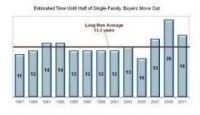
A recent article published by NAHB shows that, based on a long-run calculation that averages mobility tendencies over a number of years, the typical buyer of a single-family home can be expected to stay in the home approximately 13 years before moving out.

This work updates a previous article that used data from the American Housing Survey (funded by the Department of Housing and Urban Development and conducted in odd-numbered years by the Census Bureau) through 2007. The new study incorporates AHS data through 2011.

The mobility tendencies observed in the 2011 data imply that the expected length of stay in an owner-occupied, single-family home would be about 16 years (the time it would take half of single-family buyers to move out). However, 2011 is likely to be an atypical year, so the article repeats the analysis using mobility tendencies observable in earlier years, with results as shown in the figure below.

If a single estimate is needed for how long buyers who move in today or in the near future can be expected to remain in their homes, the article recommends 13 years, based on the rounded average across all data points shown in the figure.

The article also shows that, over the 1987-2011 period, the expected length of stay in a single-family home has been consistently longer for trade-up buyers than for first-time buyers. Averaged over those years, the expected length of stay in a single-family home is about 11 and a half years for first-time buyers, compared to 15 years for buyers who have owned a home before.

For more details, see the full article “Latest Calculations Show Average Buyer Expected to Stay in a Home 13 Years” published as the January 2013 Special Study in NAHB’s HousingEconomics.com.

View this original article on the NAHB blog, Eye on Housing.

Posted in Home Ownership
Jan. 9, 2013

Americans Continue to Expect Growth in Home Prices

Consumer confidence in the housing sector grew last month, marked by continued positive attitudes toward home price, rental price, and mortgage rate expectations, according to Fannie Mae’s December National Housing Survey results.

The growing belief held by Americans that these housing indicators will climb in 2013 may inspire a boost in home purchase activity during the coming months. However, while consumers seem confident that housing activity is on the rise, their outlook toward the economy and personal finances appears to have resumed a more unsettled trend following a show of optimism in November.

"The highest share of consumers in the survey’s two-and-a-half-year history expect home prices to increase in the next 12 months. This view is consistent with Fannie Mae's expectation that home prices will rise going forward on a national basis. Combined with consumers’ growing mortgage rate and rental price increase expectations, the positive home price outlook could incentivize those waiting on the sidelines of the housing market to buy a home sooner rather than later and thus support continued housing acceleration,” says Doug Duncan, senior vice president and chief economist of Fannie Mae. “Despite continued strengthening in the housing market, consumers’ concerns over the fiscal cliff and debt ceiling have caused considerable volatility in their perceptions of the larger economy. This uncertainty seems to be prompting a growing share of consumers to expect their personal finances to worsen and may contribute to weaker near-term economic growth.”

Below are a few of the top survey highlights:

Homeownership and Renting

• The average 12-month home price change expectation jumped to 2.6 percent, the highest level since the survey’s inception in 2010.
• At 43 percent, the share who believe home prices will go up in the next 12 months reached the highest level recorded, up 6 percentage points over November.
• The percentage who think mortgage rates will go up continued to rise, increasing by 2 percentage points to 43 percent, the highest level since August 2011.
• Twenty-one percent of respondents say it is a good time to sell, a 2 percentage point decrease from last month’s record high, but a 10 percentage point increase year over year.
• At 4.4 percent, the average 12-month rental price expectation hit the highest level since the survey’s inception, up 0.4 percent over last month.
• Forty-nine percent of those surveyed say home rental prices will go up in the next 12 months, a slight increase from last month.
• The share of respondents who said they would buy if they were going to move decreased slightly to 66 percent.

The Economy and Household Finances

• At 39 percent, the share of respondents who say the economy is on the right track fell by 5 percentage points from last month’s survey high.
• The percentage who expect their personal financial situation to get worse over the next 12 months continued to rise, reaching 20 percent and the highest level since August 2011.
• Twenty-two percent of respondents say their household income is significantly higher than it was 12 months ago, a slight increase over last month and a 5 percentage point increase over September.
• Thirty-seven percent reported significantly higher household expenses compared to 12 months ago, a 3 percentage point increase over the past month and the highest level since December 2011.

For more information, visit www.fanniemae.com.

Jan. 7, 2013

Get Your Offer Accepted

As the market shifts from a buyer's market, it's good to know how to improve your chances to have the seller accept your offer.

signature.jpg

Once you decide on a home, don't waste time; write an offer and submit it as soon as possible. Competing with another buyer happens more frequently than you'd expect. Multiple offers are a seller's advantage but here are some tips to level the playing field:

  • Realistic offer - don't give the impression you're trying to "steal" the property. Submit comparable sales that justify your offer.
  • Pre-approval letter - this satisfies seller's biggest concern that an unqualified buyer will unnecessarily take the home off the market and the seller will lose other opportunities.
  • More earnest money - it shows you're serious and makes the seller feel like the contract will actually close.
  • Minimize contingencies - from a seller's standpoint, each contingency is one more reason why the sale won't go through. They feel the home is "off the market" and they're in limbo.
  • Shorten inspection period - your agent can help you set a reasonable date but let the seller know you're willing to close prior to that if possible.
  • Write a personal letter to the seller telling them why you want their home - this can be the emotional connection to the seller that makes the difference in you getting the home.

A seller wants to feel confident that the offer they accept will actually close so they can plan for their next move. Following tips like these can definitely affect negotiations and help put together an offer that is more likely to be accepted.

Jan. 3, 2013

Fannie Mae and Freddie Mac Help More Than 2.5 Million with Foreclosure Prevention Actions

Fannie Mae and Freddie Mac completed more than 134,000 foreclosure prevention actions in the third quarter of 2012, bringing the total foreclosure prevention actions to more than 2.5 million since the start of conservatorship in 2008 with nearly 1.3 million of those actions being permanent loan modifications. These actions, which have helped more than 2.1 million borrowers stay in their homes, are detailed in the Federal Housing Finance Agency’s third quarter 2012 Foreclosure Prevention Report, also known as the Federal Property Manager’s Report.

The quarterly report has information on state delinquencies and an updated, interactive Borrower Assistance Map for Fannie Mae and Freddie Mac mortgages, with information on delinquencies, foreclosure prevention activities and Real Estate Owned (REO) properties.

Also noted in the report:
• Year-to-date, Fannie Mae and Freddie Mac have completed nearly 411,000 foreclosure prevention actions.
• Nearly 38,000 short sales and deeds-in-lieu were completed in the third quarter, up 4 percent compared with the second quarter.
• 45 percent of troubled borrowers who received loan modifications in the third quarter had their monthly payments reduced by more than 30 percent.
• More than one-third of loan modifications completed in the third quarter included principal forbearance.
• The number of the Enterprises’ delinquent borrowers has declined 9 percent since the beginning of 2012.

REO inventory continued to decline as property dispositions outpaced property acquisitions during the third quarter.

For more information, click here.

Jan. 3, 2013

Trends in Baby Furniture: Unique New Designs That Combine Comfort and Practicality

Decorating the nursery is a distinct pleasure for most expectant parents. But it isn’t easy to choose furniture and accessories that offer style, comfort and practicality that will last for many years.

Design mavens at the ABC Kids Expo in Louisville, Ky. spotlighted six new products for parents who are looking for something different. They aren’t cheap, but they offer unique and modern styles created with beauty, safety and comfort in mind:

• The Babycotpod – The most contemporary bassinets ever, Babycotpod designs feature an egg-shaped collection of baby furniture that is handcrafted of fine hardwoods with custom-painted exteriors. The Nuna and Cascara models offer a unique, sophisticated and comfy sleep space with built-in hood and carry handles. Prices begin at about $800.
• The Gro-Crib - A crib that turns into a toddler bed, a day bed, a desk and a play table – with no screws or hinges. Designer David Singelyn’s crib has no mechanical fasteners and takes only minutes to put together. Not cheap at $1,400, but when you consider how many pieces of furniture you get in one, it’s great for those who can afford it.
• Baby Dee Dee Sleep Nest – A cross between a soft, washable duvet and a wearable baby sleeping bag, this new innovation with shoulder snaps and a glow-in-the-dark zipper wraps baby in a soft cocoon, eliminates the need for loose blankets, and makes it easy to change diapers in the dark. Costs about $35.
• The Petit Nest – An eco-friendly, made in America collection of cribs, dressers, gliders, wall art and more designed to last long beyond baby’s early years. Whimsical, playful styling with a distinct point of view that can later be integrated into the design of any home. Cribs and dressers cost between $1,400 and $1,700.
• Ububub cribs – Unique, modern wood cribs with smooth, rounded edges and clear Lucite sides for best visibility for you and your baby. They feature a low profile, adjustable mattress positions, and no bars for baby to get stuck in. Cost? About $1,600.
• Spa Baby Hot Tub – A soothing green “baby bucket” that calms squirmy babies and keeps them safe at bath time. Provides a chest-high warm soak in a natural, womb-like position. Cost is about $38.

 
Dec. 31, 2012

Home foreclosure rate declines in Beaufort County

Home foreclosure rate declines in Beaufort County, could be a good sign of stability in the local housing market. Investors and local home buyers in Beaufort County must have invested well and took pride on their home ownership

 
"Hilton Head purchasers may be more affluent. They had more cash for that home purchase. They had more of a safety net,"

"One of every 423 housing units in the county went into foreclosure in November. That's a lower rate than the one in every 339 reported in November last year, according to data from RealtyTrac, a California-based firm that tracks foreclosure filings on houses, condominiums and villas."


Read More Here: islandpacket.com

Dec. 31, 2012

Resolutions

resolutions.jpg

After spending the holidays with family and friends, this is a time of the year to start thinking about changes to make in our lives, both personal and in business. We wanted to share one of ours with you.

Our goal is to become your REALTOR® for life. We want you to think of us first when you need to buy or sell and that you’ll recommend us to your friends too. That kind of trust has to be earned and we’re committed to helping you be a better homeowner even when you’re not buying or selling.

The strategy is simple. A well-informed homeowner will make better decisions. We’ll periodically offer information through articles and social media on a wide variety of home-related topics like maintenance tips, tax law changes, financing suggestions, insurance, equity building strategies, and rental property investments.

Please contact us if you need a recommendation on a service provider. Our experience has built a list of reputable and reasonable contractors that you can rely upon. When you have any kind of home-related questions, I hope you’ll have the confidence to call us.

Happy New Year. We sincerely look forward to helping you or your friends.

Dec. 29, 2012

FHFA House Price Index Up 0.6 Percent in November

U.S. house prices rose 0.6 percent on a seasonally adjusted basis from October to November, according to the Federal Housing Finance Agency’s monthly House Price Index (HPI). The previously reported 0.5 percent increase in October was revised upward to a 0.6 percent increase. For the 12 months ending in November, U.S. prices rose 5.6 percent. The U.S. index is 15.2 percent below its April 2007 peak and is roughly the same as the August 2004 index level. National home prices have not declined on a monthly basis since January 2012.

For the nine census divisions, seasonally adjusted monthly price changes from October to November ranged from -1.0 percent in the East North Central division to +2.1 percent in the Mountain division, while the 12-month changes ranged from +0.5 percent in the Middle Atlantic division to +14.8 percent in the Mountain division. FHFA uses the purchase prices of houses with mortgages owned or guaranteed by Fannie Mae or Freddie Mac to calculate the monthly index. Monthly index values and appreciation rate estimates for recent periods are provided in the table and graphs on the following pages.

For more information, click here.