HiltonHeadRealtySales.com's Blog

Jan. 17, 2014

Increase Referrals to Increase Success

Everyone has to start somewhere. Whether you’re new to the work force or only new to the real estate industry, your literal or metaphorical Rolodex might be a bit bare. But as a real estate professional, your success relies on who you know, and more importantly, who knows you. So gather your contacts to get a jump-start on increasing your business referrals.

First, start by assessing all of your existing personal and professional contacts, regardless of the industry. Although agents, stagers, and mortgage brokers are essential components to a referral network, you’ll want to include as many quality connections as possible; everyone—from a mail carrier, to a hairstylist, to a restaurateur—will have real estate needs at one time or another (or know someone else who does). But it’s important to have a strategy behind your networking. Make sure you’re making the right connections for the right reasons, and your business will soar.

Once you’ve established your existing network, look to expand in your local market. Either join a networking group or establish your own. Sign up with your local chamber of commerce as a registered business and attend their meetings. Also, consider going to business-related neighborhood association gatherings and your personal neighborhood meetings. It’s imperative to be an involved member of the community to make connections and encourage referrals.

In addition to your personal website, establish and maintain social-networking business profiles for a comprehensive online presence; use these online tools to interact with your clients on a regular basis, and keep your finger on the pulse of what’s happening in your community and beyond. Be careful not to use this resource as just another platform for a sales pitch. Instead, it should make you relatable to your current and potential clients. You’ll also want to offer universal real estate and home design insight to give your business some additional value.

Because you can’t shake every potential client’s hand in person at first (as is the case with faraway buyers), it’s important to brand yourself both online and through print marketing, as an approachable, local expert. Out-of-town buyers are significant referrals; they are often more motivated to make purchases, and because they don’t know the area well, they’ll look to you for additional referrals for the best drycleaner, pizza place, and more, which only enhances your professional connections. Before you know it, you’ll be providing referrals to agents outside of your local network and collecting a handsome referral fee, too.
Jan. 15, 2014

Hilton Head Real Estate Market Report - December 2013

Which snapshot would you like?

Hilton Head Island Area Market Stats (MLS)*

  • Closed Sales YTD: 3,620 (+9.5%)
  • Pending Sales YTD: 3,793 (+11.1%)
  • Median Price - Area wide YTD: $254,000 (+12.4%)
  • Average Price - Area wide YTD: $339,916 (+7.5%)
  • Median Price - Hilton Head Island Villas/Condos YTD: $225,000 (+20.3%)
  • Median Price - Hilton Head Island Detached Homes YTD: $480,000 (+6.2%)
  • Median Price - Mainland Detached & Villas/Condos YTD: $213,000 (+12.2%)
  • Housing Inventory: 2,304 Homes for Sale (-11.5%) - 7.3 Months Supply (-20.3%)

      *Current as of Year End 2013. Next update for First Quarter 2014 to be released mid- to late-April

To see both reports in full, complete with graphs, click on


View More
Jan. 14, 2014

MBA Lowers 2014 Mortgage Originations Forecast

The Mortgage Bankers Association (MBA) lowered its forecast for mortgage originations in 2014 by $57 billion to $1.12 trillion for the year, based on declining mortgage application activity and increasing interest rates.

“Despite an economic outlook of steady growth and a recovering job market, mortgage applications have been decreasing – likely due to a combination of rising rates and regulatory implementation, specifically the new Qualified Mortgage Rule,” says Mike Fratantoni, Chief Economist for MBA. “As a result, we have lowered our expectations for both purchase and refinance originations in the first half of 2014. Purchase originations are now expected to be $677 billion for 2014, compared to $711 billion forecast previously. Compared to 2013, purchase originations are expected to increase by 3.8 percent.”

Refinance originations were revised lower as well and are now expected to be $440 billion in 2014, compared to $463 billion estimated previously. The updated refinance total is around 60 percent lower than 2013 refinance originations.

For more information, visit www.mortgagebankers.org.

Jan. 14, 2014

30-Year Fixed Mortgage Rates Plummet 16 Basis Points

The 30-year fixed mortgage rate on Zillow(R) Mortgage Marketplace is currently 4.23 percent, down 16 basis points from 4.39 percent at this time last week. The 30-year fixed mortgage rate hovered near 4.39 percent for the majority of the week before plummeting to 4.29 percent on Friday. Rates continued to fall over the weekend and early this week.

"Rates dipped after Friday's jobs report revealed employment below expectations by a wide margin. Although disappointing, the jobs report on its own is unlikely to offset the overall upward trend in rates," says Erin Lantz, director of mortgages at Zillow. "This week, we expect rates to remain fairly stable as markets await additional data that might reinforce or contradict the relatively subdued economic tone set by the jobs report."

Zillow's real-time mortgage rates are based on thousands of custom mortgage quotes submitted daily to anonymous borrowers on the Zillow Mortgage Marketplace site, and reflect the most recent changes in the market. These are not marketing rates, or a weekly survey.

The rate for a 15-year fixed home loan is currently 3.20 percent, while the rate for a 5-1 adjustable-rate mortgage (ARM) is 2.83 percent.

View the current rates for 30-year fixed mortgages by state at http://www.zillow.com/mortgage-rates.

Jan. 13, 2014

January Is the Perfect Time for Conducting a Home Inventory

In recent years, I have touched on the subject of ensuring you are insuring your home and possessions properly. You don't want to pay for insurance you don't need - but in the unlikely event of a claim, you want to be sure you have adequate coverage to recover!

Now that the holidays are over, it is the perfect time to conduct an updated home inventory according to the Professional Insurance Agents of Connecticut State Inc. (PIACT).

Augusto Russell, CIC, and PIACT's president says homeowners and renters insurance can include coverage for valuable items they may have purchased or received as gifts over the holidays.

Russell says contents coverage is part of a typical homeowners insurance policy, but amounts of coverage vary, and holders may have special coverage limitations on items like jewelry, furs, and fine arts. Russell warns these limitations vary by company and may not be enough to cover the total value of these items.

Extra coverage called personal property “floaters” will provide specific insurance for the value of the insured property. Most insurance companies will require a homeowner to have the items appraised to determine the amount of coverage.

To make sure your items are protected adequately, PIACT suggests:

  • Contact your insurance agent immediately. Let your agent know you now have an expensive piece of jewelry or other costly items.
  • Have the item(s) appraised. It is important to have the expensive items appraised properly. If you purchase a floater or endorsement, your premium will be based on this amount. In the event of a claim, you will be compensated for this dollar amount.
  • Take a picture of the item or items and add them to your home inventory. Keep copies of any receipts, because you may need to forward a copy to your insurer.
  • Keep a copy of your insurance policy and the inventory of your home in a safe deposit box - preferably in a secondary location such as an office or relatives home if possible.
Jan. 9, 2014

Mortgage Rates Dip to Start 2014

Mortgage rates pulled back, with the benchmark 30-year fixed mortgage rate retreating to 4.64 percent, according to Bankrate.com's weekly national survey. The average 30-year fixed mortgage has an average of 0.34 discount and origination points.

The average 15-year fixed mortgage was down to 3.69 percent, while the larger jumbo 30-year fixed mortgage inched higher to 4.73 percent. Adjustable rate mortgages were mostly lower, with the average 5-year ARM settling at 3.46 percent and the 10-year ARM slumping to 4.19 percent.

Mortgage rates started out 2014 by pulling back, helped by a few down sessions in the stock market. This week's decline largely unwinds the increase in mortgage rates seen in the last week of 2013. Mortgage rates are closely related to yields on long-term government bonds, so as those bond yields move up and down, mortgage rates typically follow.

On May 1, 2013, the average 30-year fixed mortgage rate was 3.52 percent. At that time, a $200,000 loan would have carried a monthly payment of $900.32. With the average rate currently at 4.64 percent, the monthly payment for the same size loan would be $1,030.08, a difference of almost $130 per month for anyone that waited too long.

Findings:
30-year fixed: 4.64 percent - down from 4.69 percent last week (avg. points: 0.34)
15-year fixed: 3.69 percent - down from 3.73 percent last week (avg. points: 0.25)
5/1 ARM: 3.46 percent - down from 3.52 percent last week (avg. points: 0.26)

Bankrate's national weekly mortgage survey is conducted each Wednesday from data provided by the top 10 banks and thrifts in the top 10 markets. For a full analysis of this week's move in mortgage rates, go to http://www.bankrate.com/.

Jan. 9, 2014

Average U.S. Home Insurance Premium Costs Decline to $823

According to the HomeInsurance.com RateReport, average 12-month U.S. home insurance premiums fell from December 2012 to December 2013. The average annual premium in December 2013 was about $823, down 9.5 percent from the $900 average at the end of 2012. Premiums had increased for three years in a row before that.

The average price of home insurance fell despite an increase in the median price paid for existing homes, according to the National Association of REALTORS®. The organization says the national median for existing homes in November 2013 was $196,300, up 9.4 percent from the same month in 2012.

The average 12-month cost of home insurance has fallen every month since March 2013. "We think policyholders benefit greatly by knowing where premiums stand in their states," said Jana Bell, Vice President of HomeInsurance.com.

"New homebuyers can sometimes face sticker shock when they start quoting home insurance after they have gone into contract," said Bell. "Home buyers should not only research the average costs in their specific area but also get comparative quotes as premiums can vary greatly from home to home."

According to the RateReport, Oklahoma policy holders paid the highest average annual premium in December – nearly $1,491. Contrast that with homeowners in Oregon, who paid $454.

Rates fell in 28 states. The largest year-over-year declines in premiums came in Tennessee, where costs fell 34.2 percent; Mississippi, where they dropped 26.9 percent; and Kansas, down 22.3 percent. The largest year-over-year increases occurred in Delaware, where average 12-month premiums were up 19.2 percent, New Jersey, where they rose 8.4 percent; and Nevada, up 6.7 percent.

Source: HomeInsurance.com 

Dec. 27, 2013

Homeowners Consumer Center Updates 'Chinese Drywall' Warnings

A recent visit to the Homeowners Consumer Center (homeownersconsumercenter.com) website revealed a recent reminder for homeowners about the continuing issues related to "Chinese drywall."

Before you purchase a home in Florida, Alabama, Mississippi, Louisiana, Southeast Texas, or Virginia, the Center is advising to make sure you have the home checked for toxic Chinese drywall by a qualified building inspector. The time frame of concern should be if the house was built or renovated between 2000 and early 2009.

The Center's pointed advice is: "Do Not Purchase a Home That Is Known to Have Toxic Chinese Drywall."

Homeowners who suspect they might have the toxic Chinese drywall in their home should check the copper coils on their air conditioning units. If the AC copper coils have turned black, or a grayish black they should contact the Chinese Drywall Complaint Center at 866-714-6466.

Homeowners, building owners, or occupants in the US Southeast may have noticed corroded, or black electrical wiring in their walls in properties built, or remodeled since 2000. Many homeowners who have the toxic Chinese drywall in their home might have copper ground wires in the electrical receptacles that have turned black in the US South.

Homeowners who suspect their home may have the Chinese drywall can remove electrical receptacle plates to see if the copper ground wire has turned black. If a homeowner in any state sees this, they should also call the Chinese Drywall Complaint Center immediately.

According to the Center, Toxic Chinese Drywall Symptoms also include:

  • Oven, or stove elements, or refrigerator coils may have failed in the homes, or condominiums a number of times.
  • The Homeowners Consumer Center has also discovered that computer, TV sets, radios, DVD players, smoke detectors microwave information display panels may have failed in homes, where the toxic Chinese drywall is present.
  • Light bulbs in homes with toxic Chinese drywall may burn out at a much faster rate than specified by the manufacturer.

The Homeowners Consumer Center is part of AmericasWatchdog, a national consumer advocacy group focused on consumer protection and corporate fair play. To learn more, visit: AmericasWatchdog.com

Posted in Home Ownership
Dec. 22, 2013

New-Home Production Tops 1 Million in November

Led by a solid increase in both single-family and multifamily starts, nationwide housing production rose 22.7 percent to a seasonally adjusted annual rate of 1.09 million in November, according to figures released by the U.S. Department of Housing and Urban Development and the U.S. Census Bureau.

“This report is in line with our latest survey, which shows that builders are increasingly confident that buyers who have sat on the sidelines are feeling more secure about their economic situation and are now moving to purchase new homes,” said Rick Judson, chairman of the National Association of Home Builders (NAHB) and a home builder from Charlotte, N.C.

“This upward trend could be even stronger if not for persistently tight lending conditions for buyers and builders facing rising costs for building materials, lots and labor.”

“Single-family and multifamily starts are at five-year highs, providing additional evidence that the recovery is here to stay,” said NAHB Chief Economist David Crowe. “We hit a soft spot this fall when interest rates jumped and the government closed down, but mortgage rates still remain very affordable and pent-up demand is helping to boost the housing market. We expect a continued steady, gradual growth in starts and home sales in 2014.”

Single-family starts posted a 20.8 percent gain to a seasonally adjusted annual rate of 727,000 units in November, which was their fastest rate since December of 2007. Multifamily production was up 26 percent to 364,000 units. Regionally, combined starts activity rose 41.7 percent in the Midwest, 38.5 percent in the South and 8.8 percent in the West, but fell 29.4 percent in the Northeast.

Overall building permits, which are an indicator of future building activity, fell 3.1 percent to 1.007 million units in November. Despite the modest decline, this was the second month that new permit issuance topped the million mark.

Regionally, total permit issuance increased 7.8 percent in the Northeast and fell 7 percent in the South, 0.4 percent in the West and 0.6 percent in the Midwest.

For more information, visit www.Nahb.org.

Dec. 20, 2013

U.S. Homes Gain 1.9 Trillion Dollars in Value in 2013; Largest Gain Since 2005

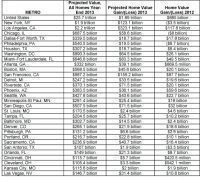
Homes nationwide are expected to gain almost $1.9 trillion in cumulative value in 2013, the second consecutive annual gain and the largest since 2005, according to an analysis of Zillow® Real Estate Market Reports.

Gains were calculated by measuring the difference between cumulative home values as of the end of 2012 and anticipated cumulative home values at the end of 2013. The overall value of all homes in the U.S. at the end of 2013 is expected to be approximately $25.7 trillion, up 7.9 percent from the end of 2012. Last year, cumulative home values rose 3.9 percent from 2011.

The gain in cumulative home values is the second annual gain in a row, after home values fell in every year from 2007 through 2011. Between 2007 and 2011, the total value of the U.S. housing stock fell by $6.3 trillion. Over the past two years, U.S. homes have gained back $2.8 trillion, or about 44 percent of the total value lost during the recession.

“In 2013, the housing market continued to build on the positive momentum that began in 2012, after the housing market bottomed. Low mortgage rates and an improving economy helped bring buyers into the market, boosting demand and driving prices up,” said Zillow Chief Economist Stan Humphries. “We expect these gains to continue into next year, though at a slower pace. The housing market is transitioning away from the robust bounce off the bottom we’ve been seeing, toward a more sustainable, healthier market. This will result in annual appreciation closer to historic norms of between 3 percent and 5 percent.”

Almost 90 percent of the 485 total metro areas analyzed nationwide experienced home value gains in 2013. Of the 30 largest metros, those with the largest gains in overall value as measured by total dollar volume include Los Angeles ($323.1 billion), San Francisco ($159.2 billion), New York ($123.1 billion), Miami ($83.3 billion) and San Diego ($71.5 billion).

For more information, visit Zillow.com.